
"If you want to go far, go together!"
Keeping versus Giving Contact Reports


The thing I love the most about this Substack project is the responders! So far, 13 of my favorite writers and fundraisers have shared their wisdom in these posts — it is so fun! I have to say that today’s responder is my favorite fundraiser on the entire planet— Luke Hanson. Luke is Director of Planned and Reunion Giving at Gustavus Adolphus College. And he is my son. Luke has always been sincerely interested in people — it is his superpower in fundraising work. The best thing that happens at fundraising conferences these days is when someone says, “Oh, you’re Luke’s dad!” Yes I am.
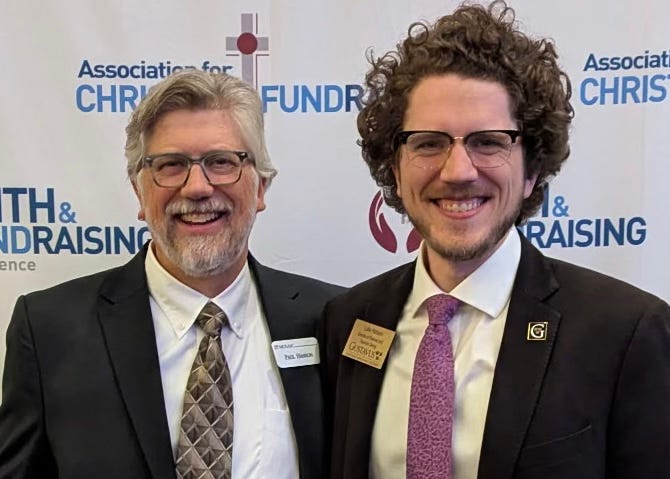
This is written by Luke Hanson, MBA, CFRE, in response to last week’s post “Stop Keeping Records!” (here).
I love the idea that we can “give” our contact reports instead of “keep” them. Here are my reflections on how this semantic shift can enrich our work as fundraisers.
Seeing ourselves in the long story, with all the characters
For me, a key insight of Paul (a.k.a. Dad)’s piece is that the word “keeping” (understood as an opposite to “giving”) implies a certain level of short-sighted individualism. The word “giving,” by contrast, is inherently relational, communitarian and attentive to the long-game.
It brings to mind an African proverb I love:
“If you want to go fast, go alone. If you want to go far, go together.”
It’s an invitation to live and work together. In fundraising, that includes writing good action reports
When we get busy it’s easy to neglect writing a contact report within a day or two of a visit, while the details of a conversation and a donor’s body language and energy are still fresh. As responsibilities pile up, it’s tempting to neglect writing real contact reports altogether. After all, the voice in my head says, “If I’m the only person at my institution who’s really connecting with this person anyway, what’s the big deal?”
A fundraiser can get away with that behavior for a while — going fast, but going alone. But if we want to go far, we have to go together.
That means fastidiously recording the details of our conversations and knowledge about the donors we serve, and proactively sharing that information with others at our institutions that can and should be trusted with it.
It means recognizing that “it takes a village” to cultivate a donor and raise a million.
It means setting up our successors for, well, success.
It means accepting that we, the fundraisers, are not the protagonists in the stories of donors’ generosity to the institutions and missions they love.
We who work with major donor prospects know that a donor’s first major gift is probably not the biggest gift they can make. If a fundraiser carefully and patiently builds the donor’s trust over time, usually with the help of others at their institution, the donor’s philanthropy will increase. In many cases, the gift officer who facilitated a donor’s first major gift is not present when that donor makes their most transformational gift; by that time, someone new has filled their shoes.
“If you want to go far, go together.” Write your contact reports!
Kindness to yourself
I think Paul is right: in life (and in the profession of fundraising) it’s important to be a good friend to yourself. Writing good contact reports is a concrete, vital way of doing so.
The most important part of our work is building strong relationships with our donor prospects. We can make progress towards building strong relationships by listening carefully during conversations. But to build sturdy, trusting relationships in the long term requires that we remember details from previous conversations and build upon them each time we talk with our donors. And let’s face it — committing those details to memory for 150 households (and keeping them straight) is an impossible proposition. We’re only human.
Do your human brain a solid: make good records of your interactions with donors–and do so right away! Here’s one method: when I’m back in my car after a visit, I open a recording app on my phone and record a play-by-play account of the visit.
Interestingly, I have found that the act of verbally recording a recap of a visit and writing a good report helps me better remember the details — I have less need to reread it!
Start with key big-picture takeaways (main information related to their giving, next-steps);
Follow with more nuanced details (interests they told me about, things they shared about their families and their assets, observations about body language or conversation style);
Multiple visits in a day? Record between visits! This mitigates confusing the details of one conversation with those of another.
I’ve also found the act of writing the report helps me to synthesize that conversation and come up with a more clear-eyed plan for my next steps. It makes me a better, happier fundraiser.
When you get the little details you want to remember written down, you can really pick up the next conversation where you left off. You’re doing a serious kindness to your future self, and setting yourself up for future success.
It improves the donor’s experience as well.
Kindness to your donor
A good contact report can set you up to deepen trust with donors during subsequent conversations. You will be able to flavor the conversation with indications that you were listening carefully to them:
“Last time we saw each other, you were anticipating a surgery: how are you doing?”
“Do I remember correctly that you’re interested in opportunities to support Gustavus students doing research, specifically in Biochemistry?”
On many occasions, when I have remembered something important to them, the donor responded as though I have given them a gift.
When that happens, I feel as though I have received a gift in return! For me, the joy of this profession is when I sense that the donor feels at ease with me, that they trust me, that they know I am earnestly interested in them. To be entrusted with the task of building relationships like these is a joy and a privilege.
Joy in generosity
As fundraisers, we profess the joy and power of giving. We have the privilege of witnessing how the act of giving enriches the lives of donors — not only the organizations or individuals who receive their generosity. So it’s only natural that we, who promote the benefits of giving, should seize the opportunity to think of our contact reports as a gift.
Giving gifts feels good! It is so much more pleasurable than doing chores. If we can conceive of mundane but essential tasks like writing contact reports as “giving gifts” instead of “completing chores,” we all stand to feel happier and more purposeful.
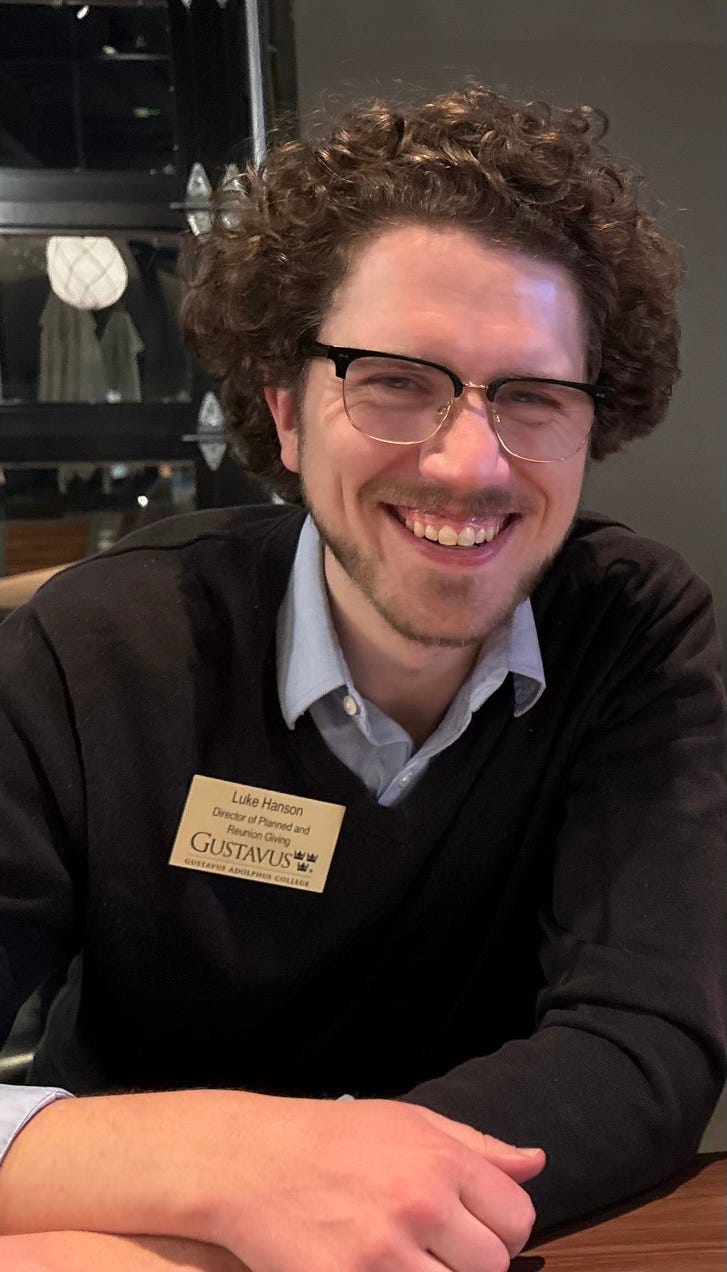
Luke Hanson is Director of Planned and Reunion Giving for Gustavus Adolphus College. He served as Development Director for Concordia, Saint Paul. Luke is a graduate of Luther College. He and his wife Jessa are parents of one daughter.
Kelly Wendell is the editor of “To Be A Fundraiser.” She is Coordinator of Communication for South Dakota State University.
 | A guest post by
|
This is a fun read and a tale of how 2 Hansons are even better than one.
Great piece, Luke!