
The Rich Get Richer
Are fundraisers complicit? Or are we change agents?

In this country there exists a dramatic wealth disparity, more extreme than most of us can comprehend. In the first two quarters of 2025, the wealthiest 1% of Americans held 29% of total household wealth, while the bottom 90% held 33%, according to the Fed. And the bottom 50%? Their wealth hardly shows on the chart.
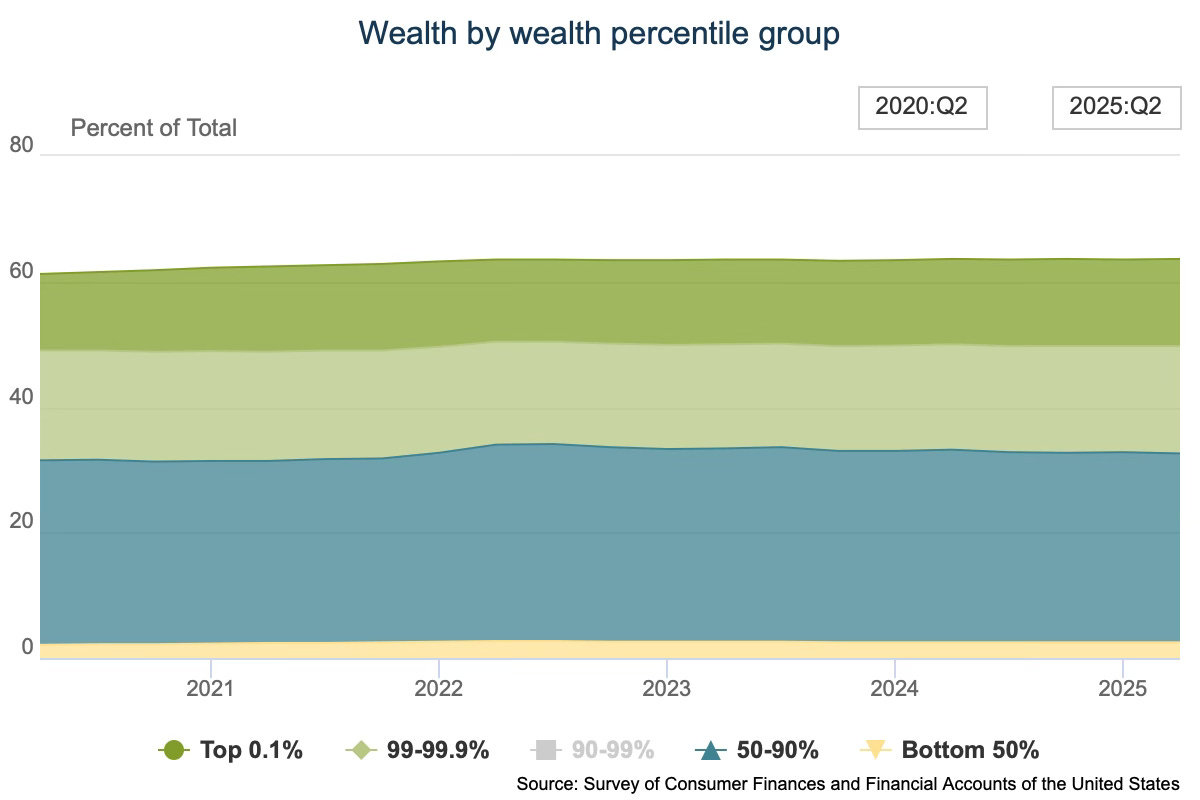
Fundraisers who solicit major gifts may wonder how we fit in such a system. Are we part of the problem? Or might we consider ourselves part of the solution?
Non-profits can’t raise a lot of money without people who have a lot of money to give.
“Philanthropy” is a word that means “love of people.” In America, we don’t take the chance that love is enough to drive charity. Our government provides additional incentives for charitable giving. Fundraisers all understand how our tax code allows donors to reduce their taxes through charitable giving. These incentives are more advantageous for people who have more wealth and who make larger gifts.
The same is true of our political system — it now openly favors the wealthy. Since the 2010 Supreme Court decision Citizens United, political influence favors rich donors and corporations. Since 2010, $4.3 billion of contributions have been made by groups that do not disclose the source of the money. $1.9 billion in the 2024 presidential election alone.
There are no limits to how much money a candidate, an elected official, even the president, can receive. Or the favors they give in return. Prizes include high-ranking offices, tariffs on competitors, presidential pardons, tax breaks for the wealthy. Tax cuts to the wealthiest 10% mean less assistance for Americans who need help.
The Supreme Court said the Citizens United ruling was a guarantee of free speech, protected by The First Amendment. The dissolution of campaign reform has at least guaranteed this: The rich get richer. Much, much richer.

Here’s the thing: The charities and non-profits we work for depend on big gifts from wealthy donors. Every gift of every size matters, to be sure. But without those donors at the top of the gift chart, our campaigns would be much less ambitious. Non-profit organizations can’t raise a lot of money unless we are supported by people who have a lot of money to give.
You have thought deeply about these things, I know. You’ve had a peek into the world of the wealthy. Learned about them as individuals, seen their hearts, heard their stories.
Love always wins.
You have probably wondered from time to time if the arc of history does indeed bend toward justice. You’ve wondered if philanthropy is a finance career, or if it really is about love.
People like you who stand in the middle, you are signs of justice. Your schools, agencies and ministries are lights in the darkness. Each donor, each gift, might be one vote in the affirmative. Because the funding is not what matters most — when people give, they also care. (See my earlier “You First” post.) And when people care, hearts can change.
Your work doesn’t just impact the people who receive the services. Your work as fundraisers sometimes helps humans find freedom from their money, and to help them gain the meaning which wealth cannot give.
We worry that we are just part of the system in which the rich get richer. Perhaps we are. I don’t think one can effect change in something unless you’re inside it. Small potatoes? We’ll see…
The miles-wide disparity of wealth remains in place. But you are in that system. Teaching and fostering the love of people. Helping good things happen. Knowing that LOVE always wins.
Feeling stuck or alone in your fundraising practice? 7-weeks of personal coaching sessions will get you moving again. Contact me at pnh333@gmail.com or send a message. —Paul
The editor of “To Be a Fundraiser” is Kelly Wendell, Coordinator of Communications at South Dakota State University.