
You First
Why you want to give to the organization that pays your salary


My friend Ron Glusenkamp is a retired pastor, a fundraising leader, a devoted husband, father and grandfather. Ron is also passionate about baking bread — Ron crafts bread of all kinds! Even pretzels. He is known for giving it away — the bread, the know-how, and his pastoral wisdom about it.
Ron has reflected deeply about the connections between bread, the Gospel and philanthropy. You’ll see what I mean in his response next week!
He often talks about how a baker forms each loaf of bread with care using their hands, the floured countertop, a basket or a pan. In this same way, when generous people make a gift of significance, they take the time to carefully “shape” that gift — the means, the method, its impact. Bakers shape their bread; we shape our giving.
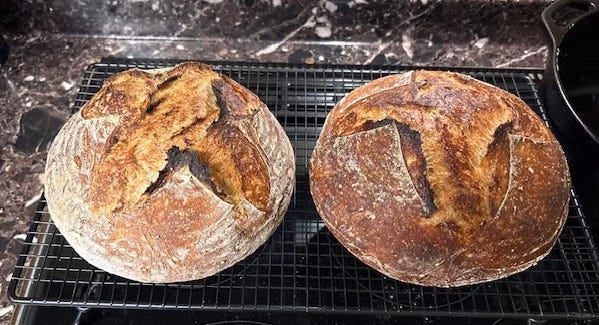
Ron likes to point out the paradox that the act of giving also shapes and forms us. He will write more about this — stay tuned!
But first, I want to ask you: How is your fundraising shaped by your giving?
Normally fundraisers evaluate their work by how we ask well. Good asking makes for good fundraising, right?
I believe there’s more. How you give will surely shape your fundraising practice, from the inside out. And if you aren’t giving, your best asking will be stunted.
If you’re a fundraiser, your giving–not just your asking– shapes your fundraising practice.
What about it? Are you giving to the organization for which you fundraise? I’m not talking $100/year on Giving Tuesday. I mean giving at a level that is significant for you.
The answer needs to be affirmative. You cannot be an effective fundraiser, asking people to support a cause, if you aren’t first supporting it yourself. It must be YOUR cause.
Personal and professional ethics demands this. Full stop.
This is a no-fail way to lead yourself. Giving money is so powerful in our lives. I don’t believe that our giving illustrates our priorities; rather, our giving creates our priorities! Where you put your money IS your priority. Jesus said, “Where your treasure is, there will your heart be also.” He didn’t say you give to what you care about. He said you will care about what you give to. Do you want to care more? Give more.
Here’s a helpful tool when you are considering a job offer from a new organization. Make your list of pros/cons, talk to friends and family, do your research. Then add one more step: Open your checkbook on the table in front of you, take up a pen.
Are you glad to make a significant charitable gift? Or are you hesitant? The answer is good information. (If you can say ‘yes’ it’s a classy way to start your tenure.)
Above all, I believe donors can discern if you are “all in” or not. Maybe there are subconscious “tells.” Maybe you say “we” more naturally. I have not normally told donors about my giving…even so, I think they knew. People deserve to trust that you are also a giver.
You can’t give at the same level as your major donors. But you can give a gift of similar proportion. I can tell this story now:
I started a new position as a major gift officer during a very rough patch financially: underwater in our house, three kids in college, going through divorce. I was tempted not to give. I thought about telling myself, “Doing the job is my gift. Being away from home counts as my donation. I’ll give when the smoke clears.” And so on.
But I knew that, in order to bravely solicit major donations, I needed to be in alignment. With the help of a friend, I figured out how to make a large insurance gift with monthly bites I could manage. Other gifts have been larger, but none was more sacrificial or more impactful on me and my work.
Your giving shapes you as a person. If you’re a fundraiser, your giving–not just your asking– shapes your fundraising practice.
One more aspect: What if you agree with me, but you honestly just aren’t feeling it? What if you don’t want to give to your non-profit? Good for you for noticing and admitting it. Your prize is getting an opportunity to learn something valuable.
Is there something within the organization you mistrust? Can this be repaired? If as a donor you have concerns, tending to this issue will be good service.
Have you lost that lovin’ feeling? You could find a way to get it back. Or you can begin to find a new gig. People do that. It will be all right.
If your generosity is slumping across your whole life, that’s another matter. Take some time, get wise counsel, and keep growing in self-awareness.
Generosity is our work. Bread doesn’t rise without yeast. If you attempt to live this fundraising life ungenerously, you’ll get crackers. That dissonance inside will produce suffering, not success.
I will not promise the other side of the equation; your generosity does not guarantee that you’ll raise big gifts. Being generous makes success possible. I do promise peace, the inner peace that alignment brings. Our giving shapes us.
Feeling stuck, resentful, worried about your fundraising practice? I have a spot in my coaching practice for you. In 7 weeks we can put you in a better place. Reach out to me.
The editor of “To Be a Fundraiser” is Kelly Wendell, Coordinator of Communication for South Dakota State University.
I found this to be true in my work. When I was aligned with the work, I could also give to the organization. Interesting to think of the giving leading the alignment.